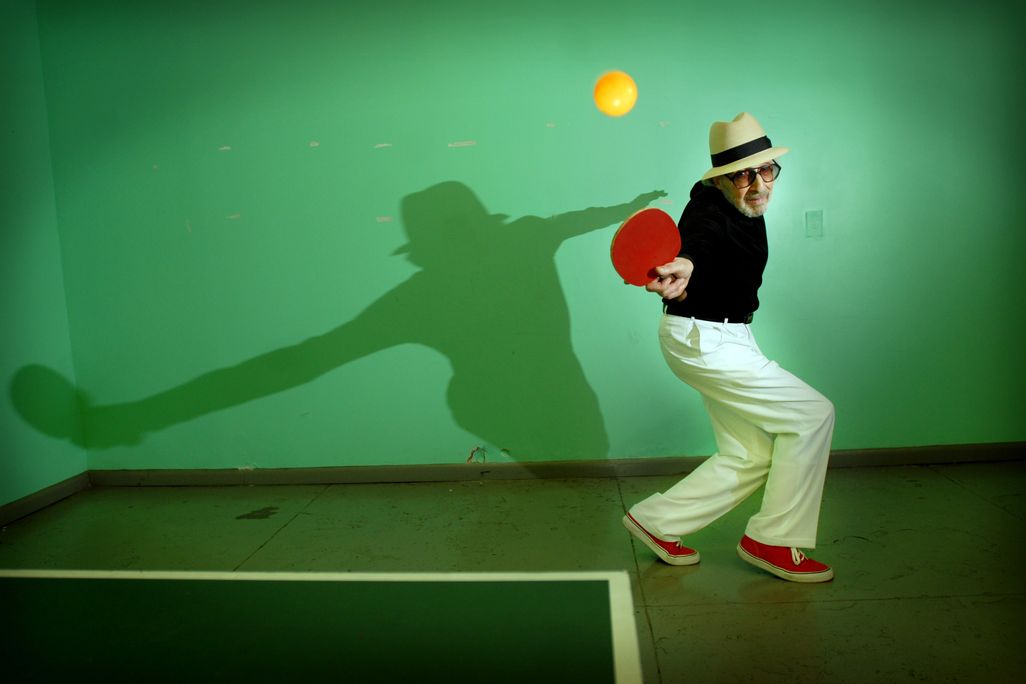
Jim Butler stood at one side of the table with his knees bent and a hardbat racket in his hand. It’s not his usual racket; Butler was one of the many young players to have adopted the much more efficient sponge racket by the mid-1990s. He didn’t have much of a choice, though. He knew what the rules of this challenge were, and he accepted them. And the rules of this particular match required Butler to play with a hardbat.
At the other side of this table stood Marty Reisman, one of the most decorated hardbat users in the history of United States table tennis. Four decades had passed since Reisman first hung his fifth World Championships medal around his neck, a medal that predated Butler’s own birth by 19 years. He won all five of those medals, as well as several national and international championships, while wielding his deadly hardbat racket.
But that hardbat was a double-edged paddle. Reisman won many accolades with his racket of choice, but his insistence on using it had also cost him a few gold medals. In fact, Reisman became one of the very first victims of the modern sponge racket when Hiroji Satoh took him down with the then-new paddle at the 1952 World Championships in Bombay, India.
Reisman’s conclusion ever since? The sponge racket was ruining the game. Modern players were no better than their elders. They were simply benefiting from much more recent technology. Other players from Reisman’s era shared that sentiment. They believed that a modern athlete would struggle to defeat an older player in a match that required both players to use classic equipment.
To test this theory, Reisman and his old-school counterparts set up a regulated, hardbat-only match with old-school rules. 21 points. Three out of five games. A payout of $10,000 for whoever would emerge as that match’s winner. All they needed to make this match happen was some unfortunate young sap who would dare step up to this challenge.
“It was this clash between old versus new, and no one really knew [who would win],” Butler’s close friend, Eric Owens, told Table Tennis TV. “The only way to know is to play for $10,000.”
No one wanted to be that sap … except for Butler. He was eager to be that sap. Butler saw this challenge, the same challenge that intimidated so many of his peers, as one of the easiest payouts of his life. Not even a best-of-five against one of the country’s most notorious table tennis hustlers set off any alarms in Butler’s mind. The two-time Olympian truly believed that he would be $10,000 richer by the end of that match.
“Jim Butler kept saying and screaming from the rooftop, ‘Anybody that thinks that this is close has no idea what they’re talking about,’” Owens said. “‘This will be a complete destruction [from] the modern era versus old technology.’”
The table was now set for a match between Reisman and Butler. But this wasn’t just a match between two men. It was a battle between old school and new school. Modern tactics versus tried-and-true methods. The up-and-coming stars against the legends of the game.
Those familiar with the stakes knew how pivotal this match would be. Umpires arrived to officiate the match. Spectators flocked to the stands. Betting would even be allowed, a privilege that Owens took full advantage of with Butler’s encouragement. Was that a risk? Absolutely. But it was a risk that Owens believed was worth a few thousand dollars, which was all he had in his checking account at the time.
When the day finally came, Reisman and Butler took the table, ready to rally for their side of this debate. The first serve was cast. The match had begun.
Owens sat nearby as Butler’s coach, his heart pounding harder than a rally-ending smash. The two players were gentle with every shot, creating a pace that Reisman was much more accustomed to. Butler looked uncomfortable with his unfamiliar weapon, a fact that Reisman seemed to be exploiting. Owens was beginning to feel the weight of his potentially empty wallet. This “easy bet” certainly wasn’t looking very easy.
Butler would eventually get a better grip on his paddle, just in time to take that first game. Owens doesn’t remember the final score, only that the difference couldn’t have been more than five points. What he does remember is Butler, sodden with sweat after that game, sitting next to him with his head buried in a towel. And Owens, who was stressed out of his mind at the time, will never forget what Butler said when asked how he was feeling.
“‘This is so easy,’” Owens said Butler told him. “‘I’m doing everything I can to make this look real.’”
Owens’s eyebrows shot toward his forehead. What a bold statement from someone who appeared to have trouble earning a narrow victory. Was this just fake confidence to keep his friend’s spirits up? Or was Butler genuinely playing to the level of an inferior competitor?
“‘There’s such a discrepancy of level that if I wanted to at any time, I could win every single point,’” Butler continued. “‘Not only would this be not entertaining for anyone, [but] it would be a crushing defeat for Marty.’”
Whether or not that was true, the assurance worked on Owens. His entire checking account was already at stake; he couldn’t afford to add another stressor. So Owens cooled off, took a deep breath, and trusted that Butler was just putting on a show for the crowd. After a few minutes, Owens’ worries finally left his mind.
And they rushed right back as soon as Butler lost a close second game.
Butler walked back to Owens, who looked much less amused than he was one game ago. Slight skepticism turned into extreme concern. A fake smile was replaced with a stern, frightened voice. He couldn’t even find the words to ask, “How are you feeling?” at first. The questions, “Are you sure you’ve got this?” and “You’re telling me this is the easiest money you’ve ever won in your life?” were much more pertinent for a man preparing to lose a few thousand dollars.
Those were all valid questions for Owens, whose stiff lips looked out of place next to Butler’s smirk.
“‘I absolutely dumped the game,’” Owens said Butler told him. “‘I will win the next two games. This is impossible to lose, but I have to make it close.’”
Owens wouldn’t be fooled by Butler’s confidence again. If this match was “impossible to lose,” then why bother putting up the charade? He knew that Butler was a fierce competitor. His friend wasn’t the type to risk his sterling reputation to protect his opponent’s spirit.
But he would do so if it would give him an opportunity to crush it again.
“‘I want to get a rematch, because I know that he thinks he can win.’” Butler continued. “‘And when I get a rematch, I will be able to do this again.’”
Butler spoke those words with his head in a towel. No one else could hear him trying to convince his friend that he wasn’t breaking a sweat, despite being drenched in it. That smirk still covered his face, and a look of confusion remained on Owens’s. This time, it was for a different reason.
“All I can think about was, ‘Is he actually hustling Marty Reisman?’” Owens said. “Is the hustler getting hustled?’”
The third game went much faster than the first two, which slowed down Owens’s rapidly beating heart. Butler took that game by about six to eight points. A point differential that matched Butler’s boldness. Now, only one game stood between Butler and a victory over Reisman.
That game came shortly afterward, and it went just as fast as the third. Butler took down Reisman to secure his match, keeping his word to Owens and sending a message on behalf of young table tennis players everywhere.
But the sweetest outcome of all? Butler’s gambit worked. Reisman and his team demanded a rematch, claiming that Butler’s new-school serve was far more advanced than anything Reisman had ever experienced. In this proposed rematch, Butler would have to serve with the same gentle backhand that Reisman served with, all while abiding by a similar set of rules to the previous match.
Those were the words Butler wanted to hear. Not only did Butler agree to a rematch, but he encouraged Reisman to stack on as many handicaps as he wanted. And Reisman certainly did. In addition to another best-of-five to 21 without any modern serves, Butler would spot Reisman a few points.
“He was so confident that Marty couldn’t score a point,” Owens said. “[He] was like, ‘I accept your offer. It doesn’t matter what serve I use, it doesn’t matter if you have a 10-0 start, I accept your offer.’”
Butler and Reisman would once again take opposite sides of a table. This time, they would play for a little more than $10,000. Owens had no involvement in this match; he learned his lesson after Butler danced with his bank account the first time. But he kept close tabs on a match that was sure to be a lot more difficult for Reisman to win.
And with all odds stacked against him, Butler beat Reisman again.
“I think that’s when it became very, very clear to both sides that there’s no comparison with the old era and the modern era,” Owens said. “When you put most modern players using old technology, with modern techniques and modern serves, there’s been an evolution of the game.”
From a physical standpoint, both of these matches should have been easy to decide. Reisman was in his 60s, and Butler was in his 20s. Reisman had long descended from his athletic peak, while Butler was in his physical prime. Reisman’s last World Championship medal was four decades ago. This match wasn’t too far off from either of Butler’s two Olympic appearances.
But what Reisman had was his absurd confidence level, which defined the player and person he was. The same bravado that would later earn him a segment on The Late Show with David Letterman was what allowed Reisman to challenge the much younger Butler twice. His competitive spirit wouldn’t let him believe that the game passed him by.
And challenging Butler twice proved that certain parts of it never did.
“I hope that he felt like he threw out the challenge, and we accepted it,” Owens said. “That’s what competition is all about.”



.png)